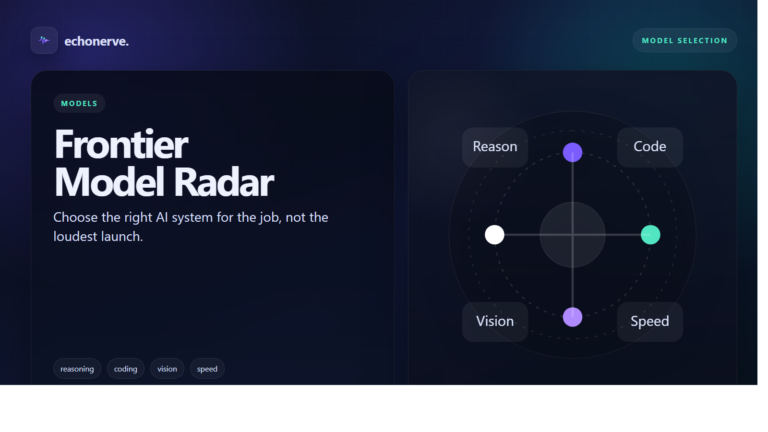
The Honest Frontier Model Comparison: Which AI Should You Actually Use in 2026?
The Honest Frontier Model Comparison: Which AI Should You Actually Use in 2026?
What This Guide Covers
- The Four Contenders
- Benchmark Reality Check
- Coding Performance Head-to-Head
- Reasoning and Science Head-to-Head
- Long Context and Memory
- Multimodal Capabilities
- Real-Time and Live Data
- Pricing: The True Cost
- Use Case Decision Matrix
- The Routing Strategy
Nobody wins everything. That is the single most important thing to understand about the 2026 frontier model landscape before reading any benchmark table or vendor claim. GPT-5.4, Claude Opus 4.6, Gemini 3.1 Pro, and Grok 4 are all extraordinary pieces of engineering — and each one is genuinely best at something the others are not. The real question is not which AI is best — it is which AI is best for your specific use case, at your price point, in your infrastructure. This guide answers that with real numbers, honest trade-offs, and a decision framework you can use immediately.
1. The Four Contenders
2. Benchmark Reality Check
Most benchmark scores are noise. MMLU has been saturated and gamed to the point that differences between frontier models are statistically meaningless. The benchmarks that actually correlate with production performance in 2026: SWE-bench Verified (real GitHub issues requiring autonomous code fixes — cannot be gamed by memorization), GPQA-Diamond (PhD-level science questions requiring deep reasoning, not recall), LiveCodeBench Pro (competitive programming filtered to remove training data contamination), and ARC-AGI-2 (novel visual reasoning requiring genuine generalization).
3. Head-to-Head: Coding Performance
| Benchmark | GPT-5.4 | Claude Opus 4.6 | Gemini 3.1 Pro | Grok 4 |
|---|---|---|---|---|
| SWE-bench Verified | 74.9% | 74%+ | 72.3% | 75% |
| LiveCodeBench Pro (Elo) | 2,741 | 2,698 | 2,887 | 2,810 |
| HumanEval+ | 94.2% | 93.8% | 92.1% | 93.4% |
Raw SWE-bench scores are separated by under 1 percentage point — essentially noise. The real differentiator is ecosystem: Claude Opus 4.6 powers Cursor, Windsurf, and Claude Code. For multi-file editing and complex refactoring across large codebases, Opus 4.6 is consistently practitioners’ choice — not because the benchmark says so, but because experienced engineers do.
Coding benchmark gaps between top models are under 1 percentage point. The real differentiator is tooling: Claude powers the coding tools most professional developers use daily. That ecosystem advantage compounds in ways no benchmark captures.
4. Head-to-Head: Reasoning and Science
| Benchmark | GPT-5.4 | Claude Opus 4.6 | Gemini 3.1 Pro | Grok 4 |
|---|---|---|---|---|
| GPQA-Diamond | 81.0% | 91.3% | 94.3% | 87.2% |
| ARC-AGI-2 | 61.4% | 68.9% | 77.1% | 65.3% |
| MATH-500 | 96.8% | 95.1% | 96.2% | 94.7% |
Gemini 3.1 Pro’s 94.3% on GPQA-Diamond is a genuine landmark — this benchmark uses questions written by PhD scientists specifically to require deep expert reasoning, not recall. The gap between Gemini and Claude (91.3%) is significant; the gap between Claude and Grok (87.2%) even more so. For scientific research, legal reasoning, complex document analysis, and graduate-level technical tasks, Gemini is the default choice.
5. Long Context and Memory
Claude Opus 4.6 leads this category decisively. Opus 4.6 introduces a 1 million token context window in beta with proprietary compaction architecture, achieving 76% retrieval accuracy at 1M tokens — versus 18.5% in earlier Opus releases. That accuracy jump is extraordinary. For tasks involving entire codebases, large document libraries, or book-length research corpora, Claude Opus 4.6 is the only serious choice. The context window alone does not matter — the retrieval accuracy at scale does.
| Dimension | GPT-5.4 | Claude Opus 4.6 | Gemini 3.1 Pro | Grok 4 |
|---|---|---|---|---|
| Context window | 256K tokens | 1M tokens (beta) | 500K tokens | 256K tokens |
| Long-context retrieval | ~68% | 76% at 1M | ~72% | ~64% |
6. Multimodal Capabilities
Gemini 3.1 Pro is the only model here with native multimodal input supporting text, image, audio, and video in a single model — no separate transcription pipelines. Gemini can watch a video and answer questions about a specific timestamp. It can listen to audio and identify emotional tone alongside content. For media companies, education platforms, customer service with recorded calls, and consumer apps with camera access, this is a genuine structural advantage.
7. Real-Time and Live Data
Grok 4 has a capability none of its competitors can replicate: real-time access to the entire X firehose. This is not browsing — it is live structured data access to the world’s largest public real-time information network. For social intelligence, brand monitoring, financial sentiment analysis, breaking news verification, and tracking public discourse, Grok’s information advantage is unique and significant. No amount of prompting fixes a training cutoff when you need live market data.
8. Pricing: The True Cost Comparison
Claude Opus 4.6 at $15/$75 per million tokens is 6-7x more expensive on input than the competition. For high-volume consumer applications, the math does not work. For low-volume enterprise workflows where cost per task is cents and value per task is dollars, the premium is trivial. Gemini 3.1 Pro at $2/$12 is exceptional value — for most organizations building at scale, it should be the default starting point, escalating to Claude only when the task genuinely requires it.
9. Use Case Decision Matrix
Ecosystem dominance in coding tools plus long context is the clear winner for professional software development.
94.3% GPQA-Diamond and best ARC-AGI-2 score make it the go-to for PhD-level analytical tasks.
1M token context with 76% retrieval accuracy — the only model that actually works at this scale.
Native multimodal processing without external transcription pipelines.
X firehose integration gives Grok live data access no other model provides.
Strong output quality at $2/$12 per million tokens. Best value per quality unit for volume.
Best-in-class tool use, safest behavior in long-horizon tasks, richest MCP ecosystem.
GPT-5.4 for Microsoft ecosystem; Gemini for Google Workspace. Ecosystem fit matters more than marginal benchmark differences.
10. The Routing Strategy: Why Smart Teams Use All of Them
The most sophisticated AI teams in 2026 do not pick one model — they build routing layers. If Gemini costs $2 per million input tokens and Claude costs $15, you route tasks to the cheapest capable model and escalate only when necessary. A practical routing heuristic: Tier 1 (Gemini Flash or GPT-5.4 Mini) for simple extraction, summarization, classification — 80-90% of volume. Tier 2 (Gemini 3.1 Pro or GPT-5.4) for general reasoning and standard code generation — 10-15% of volume. Tier 3 (Claude Opus 4.6 for complex code and long context; Grok 4 for real-time data) for high-value tasks — under 5% of volume. This architecture reduces inference costs by 60-80% versus routing everything to Tier 3.
GPT-5.4: The safe enterprise default. Massive ecosystem, broad capability, reasonable pricing. Best for teams in the Microsoft stack.
Claude Opus 4.6: The professional developer’s choice. Best for long-context reasoning, agentic coding, and tasks where accuracy justifies a premium. Not for high-volume consumer apps.
Gemini 3.1 Pro: The best overall value in 2026. Leads on reasoning benchmarks, strongest multimodal capability, costs a fraction of Claude. Should be the default Tier 2 model for most teams.
Grok 4: Uniquely valuable for real-time intelligence and raw SWE coding. The X integration is a genuine differentiator no competitor can replicate.
Get the Weekly Frontier Model Brief
Benchmark updates, pricing changes, capability shifts — EchoNerve tracks them so you do not have to.
Subscribe FreeThe 2026 frontier model question is not which one wins — it is which one is right for this task. Gemini leads on reasoning. Claude leads on long context and the coding ecosystem. Grok leads on real-time data. GPT leads on ecosystem breadth. Pick based on the job to be done, use routing to minimize cost, and revisit your choices every quarter.