Where To Focus In AI If You Want Results, Not Noise
EchoNerve is built for readers who want to use AI practically: operators, founders, marketers, researchers, engineers, and curious professionals who care less about hype and more about what can be implemented this week. This page is your site map and operating guide. If you work through the sections below in order, you will build a much sharper mental model of where the AI field stands in March 2026 and what is worth adopting now.
How To Use EchoNerve
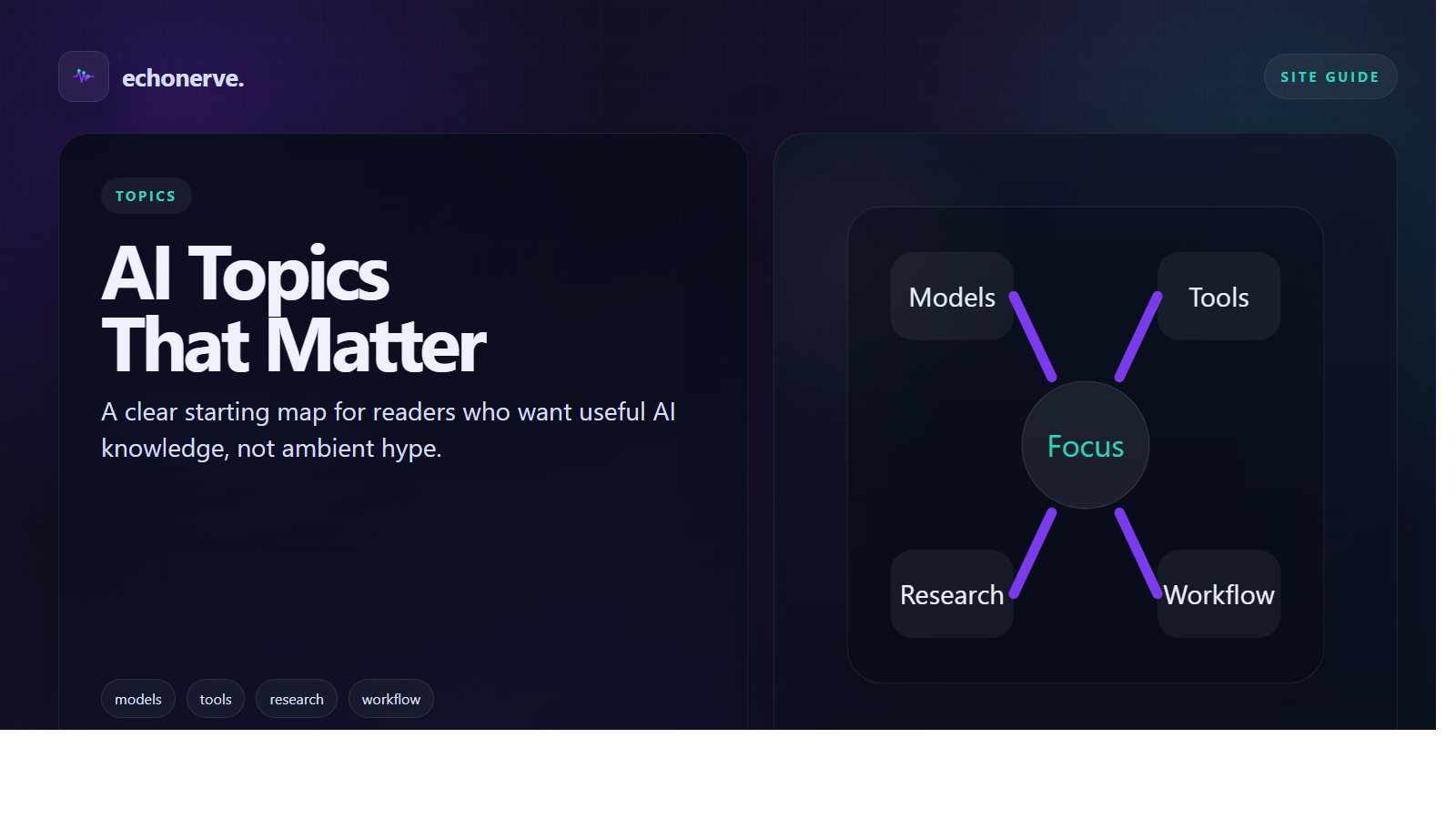
Read the site in three layers. First, use Models to understand which frontier systems are actually best for the work in front of you. Second, use Tools to assemble a stack that turns model capability into output. Third, use Research to understand which shifts are structural and which are just benchmark theater. If you only have one hour, start with the featured posts linked below and then subscribe for the weekly implementation brief.
Choose the right model for the job
Most teams still waste time by asking one model to do everything. Our model coverage is organized around practical use cases: coding, long-context analysis, multimodal work, fast drafting, and durable research. Start with the Frontier Model Guide if you want a working decision framework instead of a benchmark dump.
Turn capability into repeatable workflows
Tools matter because raw model intelligence is only half the battle. The winning stack in 2026 is increasingly about orchestration, trusted-source research, code execution, and feedback loops. Our coding agents playbook and deep research workflow guide show exactly how to make those pieces work together.
Translate frontier research into action
We care about research because it changes what you should build next. We do not care about papers as status objects. On EchoNerve, research coverage is filtered through one question: what should a serious practitioner change after reading this? The system cards briefing is a good starting point.
Build leverage, not content debt
The fastest way to get real value from AI is to create small, durable operating systems: a source-verified research process, a reusable prompt library, one repeatable automation, one model-comparison habit, and one output review rubric. Every page on this site is written to move you toward that outcome.
Your Best Next Reads
- Frontier Model Guide: What To Use For Coding, Research, Planning, and Delivery
- AI Coding Agents Practical Playbook 2026
- Deep Research With Trusted Sources: A Better Workflow For High-Stakes Work
- What Frontier System Cards Actually Tell Us About The Next 12 Months
A 30-Day Practical Learning Path
Week 1: Learn model selection. Read the models page and choose one primary model plus one backup model for your work. Write down what each is for.
Week 2: Build one trusted-source research workflow. Limit your sources, define your output format, and compare the quality of your conclusions before and after.
Week 3: Build one production-grade automation. That can be a content brief generator, a coding assistant workflow, a report synthesizer, or an internal FAQ agent.
Week 4: Introduce evaluation. Define what a good output looks like, where the model fails, and what human review must never be skipped.
Get the operator’s version of AI, every week
Our subscriber brief is designed for people who want fewer tabs, better judgment, and more useful output. Each issue focuses on what changed, why it matters, what to test, and what to ignore. If you want AI content that is easier to implement than to admire, go to Subscribe.